

For people on a visa who want to own something
You are allowed to own something.
Work authorisation and ownership are different things in the rules, and almost nobody explains the difference plainly.
They have walked every road they teach: F-1, CPT and OPT, H-1B, L-1, O-1, H-4, the green-card queue and citizenship, plus starting, buying and selling businesses on each side of that line.
The distance between reading that and doing something about it is smaller than a year of forums suggests. Answer two questions and we will name one room, or tell you plainly that nothing here is right for you yet.
Every price is printed on this page
The Library is free and ungated
Taught for people keeping the job that holds their status
Where to start
Two questions. We name one room.
Nothing is charged and no email is asked for.
Question one · where are you today
Question two · what you can spend right now
Answer the first question and the answer appears here. Usually one room, sometimes two in order, occasionally the honest answer that nothing here is right for you yet.
{{ planTotal }}
{{ planHeadline }}
Your distance
{{ planGap }}
If you wait
{{ planCost }}
- {{ p.step }} {{ p.name }} {{ p.why }} {{ p.price }}
Said plainly. {{ planNote }}
01
The distance
Before you buy anything, be certain the distance is real.
Read both columns. If the left one is not you, or the right one is not what you want, close the tab — there is nothing on this page worth your money.
A
Where you are today
- Your right to stay depends on a signature that is not yours, renewed on someone else's schedule.
- You have read forums at 1 a.m. and come away less certain than when you started.
- Nobody has told you plainly what you are permitted to own, so the idea stays an idea.
B
Where you want to be
- A route you chose on purpose, because you read the rule that governs it.
- An entity in motion, structured so it does not quietly break your status.
- Ninety days written down and dated, in your name rather than your employer's.
02
The clock
The clock you did not set.
Nobody in this market will tell you that waiting has a price, because nobody in it is paid to. The authorisation that lets you stay is renewed by somebody else, on their schedule.
We are not going to put a countdown on this page. We are going to show you yours. It takes about fifteen minutes and we do not ask for your email.
The market moves
The businesses are being bought.
Owner-run businesses change hands as their owners retire. Every year you wait, someone else buys the one that suited you, and they were not better qualified, only readier.
Your clock moves
Options close quietly.
Validity dates, priority dates and authorisation windows move whether or not you do. A year of waiting is a year of routes narrowing without anyone telling you.
The rules move
Some doors close for good.
The bank lane already closed to non-citizens once. Rules that open can shut, and when they do, the people who had already structured their entity are the ones still standing.
Every figure behind these three is cited and dated in the Library, free and ungated.
03
The Library
Everything we know is already written down, and none of it costs anything.
Thirty-six pieces on what people on a visa are actually permitted to own. Every claim is cited to the rule it came from and dated to the day it was true, because the rules move and undated advice is how people get hurt.
Nothing in it asks for an email address. If you read all of it and never speak to us, that is a good outcome and it is the one we designed for.
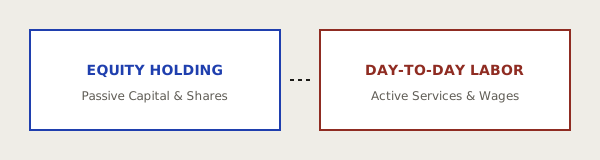 3 MIN READ
Owning versus working
3 MIN READ
Owning versus working
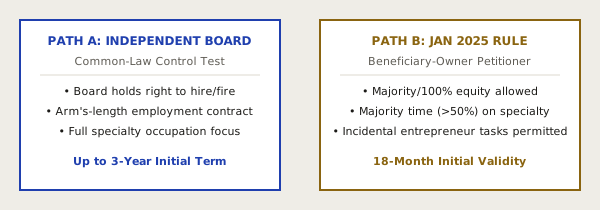 4 MIN READ
The entrepreneur rule, and the two pathways
4 MIN READ
The entrepreneur rule, and the two pathways
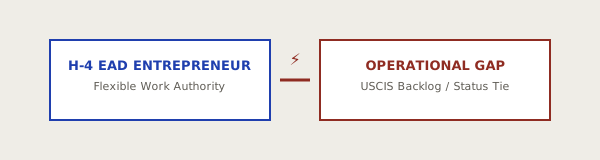 3 MIN READ
The single point of failure in an H-4 EAD business
3 MIN READ
The single point of failure in an H-4 EAD business
 2 MIN READ
Acquiring an existing U.S. business on a visa
2 MIN READ
Acquiring an existing U.S. business on a visa
04
What is in the way
Four questions, and nothing else.
Every room on this page answers one of them, and each one says which. If a room cannot name the question it closes, it should not exist.
- {{ q.n }} {{ q.q }} {{ q.answered }}
05
The rooms
One room to start in. Others that go deeper. Rooms for when a deal is live.
Most entrepreneurs need exactly one of these, and it is almost always the first. We add rooms as entrepreneurs hit walls we can teach through, never to lengthen the list.
Start here · the one room
The Immigrant Entrepreneur Cohort
Four weeks, four live sessions with the leadership team, office hours in between and for thirty days after. You leave with your route chosen, your entity in motion and your next ninety days mapped, rather than with a folder of recordings.
- {{ w.n }} {{ w.name }} {{ w.what }}
Price
{{ cohortPrice }}
{{ cohortPriceNote }}
Choose your run
September
In session, not open
October
Wednesday 7 October, 6:00 pm Pacific, four weeks
November
Wednesday 4 November, 6:00 pm Pacific, four weeks
No countdown clock. No seats-left counter. If the room is full this page says so.
When a decision is live
Card details never touch this site. Taught programmes are refundable less 5% within 24 hours, until you attend a session. One-to-one time and subscriptions are not.
06
Side by side
Every room, side by side
The same four columns for every room, so you can compare what you are actually buying: money, time, and what you hold at the end.
{{ cmpCount }}
Nothing in the catalogue fits both answers at once. Read the Library, or start over above.
07
Compared with now
You already have three alternatives. Here they are, honestly.
{{ a.cost }}
{{ a.name }}
{{ a.what }}
08
After you pay
What happens after you pay.
- {{ a.when }} {{ a.what }}
Boundaries
Said plainly
What we are, and what we are not.
Education and preparation
We teach published rules as written, on worked examples, and get you ready for the rooms where decisions are made. Where we are reading a rule rather than quoting it, we say so.
Not advice, not representation
We are not a law firm, not your attorney, not your CPA and not a brokerage. No legal, tax, immigration or financial advice, no position taken on your case, and nothing filed or signed for you.
No relationship created
Reading this site or attending a room creates no attorney–client or accountant–client relationship, and no sponsorship of any kind. Nothing said in a room is privileged.
Rules move, and dates matter. Anything we teach is accurate to the date we state and no further — check the date, then take your own facts to your own attorney and CPA. Every case turns on its own facts.